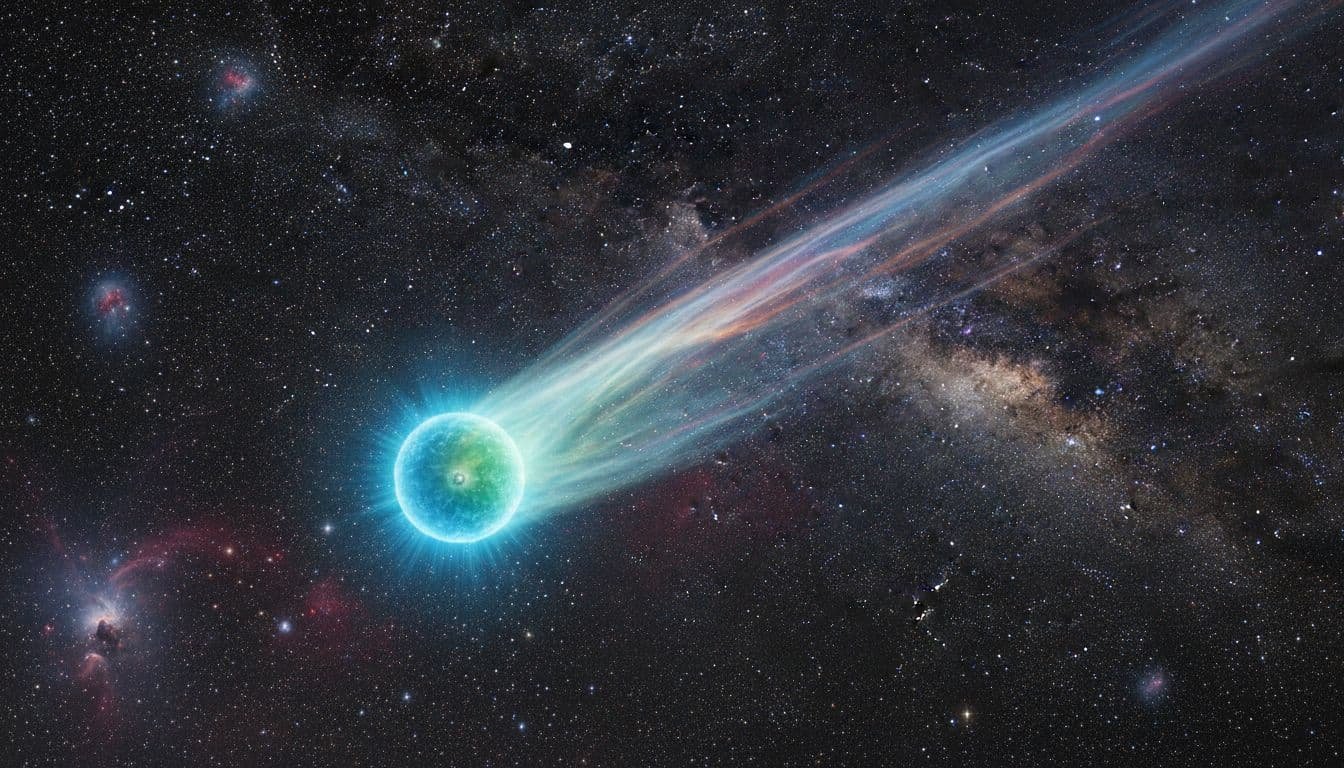
A rare visitor from deep space is putting on a show. The interstellar comet known as 3I/ATLAS is brightening and growing more active as it speeds through the inner solar system. New images from NASA and the European Space Agency (ESA) reveal jets, a glowing coma, and hints of twin tails as the object prepares for its closest pass by Earth.
3I/ATLAS is only the third confirmed interstellar object ever seen in our solar system. Unlike most comets, which formed with the rest of our planetary family, this icy traveler was born around another star and has spent most of its life drifting between suns. Now, for a short time, it is giving scientists a rare chance to study material from a distant planetary system up close.
What Is Interstellar Comet 3I/ATLAS?
Astronomers first spotted 3I/ATLAS in late June 2025. Follow-up observations quickly showed that its path through space did not match the usual orbits of comets that belong to our solar system. Instead, it follows a hyperbolic trajectory, which means it is just passing through and will not return.
By July, scientists had confirmed that 3I/ATLAS is an interstellar object, making it the third of its kind after the odd, cigar-shaped 1I/ʻOumuamua and the comet-like 2I/Borisov. Early measurements suggested that 3I/ATLAS may be even larger than those earlier visitors, with estimates placing its size somewhere between a few hundred meters and several kilometers across.
Since its discovery, the comet has been racing through the inner solar system at speeds of over 130,000 miles per hour (about 210,000 kilometers per hour). It has already swept past Mars and made a close pass around the sun. Now, it is on track to come closest to Earth around December 19, when it will still be a safe 170 million miles (about 270 million kilometers) away.
Hubble Shows a Growing Coma and Faint Tail
NASA’s Hubble Space Telescope has played a key role in revealing the true nature of 3I/ATLAS. The first images that Hubble captured earlier in the year showed only a small blur, but even that fuzzy view helped scientists place limits on the comet’s size and brightness.
In late November, Hubble returned to the comet for a closer look. This time, the new images show a much more active object. A bright central region, made up of the nucleus and a thick coma of gas and dust, sits in the middle of the frame. Around it, faint structures hint at a developing tail and jets of material streaming off the sunlit side.
As comets near the sun, frozen gases inside them begin to warm and turn directly from ice into gas. This process, called sublimation, lifts dust and icy grains off the surface. Solar radiation and the solar wind then push this material away from the sun, forming a long tail that can stretch for millions of miles.
In the Hubble images, background stars appear as stretched lines, while the comet itself remains a sharp point with a fuzzy halo. That effect happens because Hubble’s camera tracks the moving comet, not the distant stars behind it.
ESA’s Juice Spacecraft Catches the Comet in Action
Hubble is not the only eye on 3I/ATLAS. ESA’s Jupiter Icy Moons Explorer, better known as Juice, has also captured striking views while it cruises through the solar system on its own mission to study Jupiter’s moons.

In early November, Juice used one of its navigation cameras to snap a grainy but scientifically rich image of the comet. Even with a camera not designed for detailed science imaging, the photo reveals a glowing halo and signs of not just one, but possibly two tails.
ESA scientists say the brighter tail is likely the comet’s plasma tail, made of electrically charged gas that is shaped by the solar wind and magnetic fields. A second, fainter tail appears to stretch off in a slightly different direction and is probably made of small dust particles that have been pushed away from the comet by sunlight.
Together, the Hubble and Juice views give scientists a powerful, two-perspective look at how an interstellar comet behaves under the influence of our sun. Comparing these images over time lets researchers measure how fast the comet’s activity grows and how its structure changes as it moves along its path.
Why 3I/ATLAS Matters to Science
Every comet tells a story about the conditions in which it formed. Most comets in our solar system come from distant reservoirs like the Kuiper Belt or the Oort Cloud. They preserve clues about the early days of our own planetary system.
Interstellar comets like 3I/ATLAS are even more exciting, because they bring material from an entirely different star system. By studying their size, shape, color, and chemical makeup, scientists can compare how other planetary nurseries might be similar to, or different from, our own.

Early observations suggest that 3I/ATLAS behaves like a very active comet, with strong jets and a large amount of dust. By splitting the light from the coma into different wavelengths, scientists can look for chemical fingerprints of water, carbon-based molecules, and other compounds that may have played a role in forming planets and, possibly, life.
If researchers find that 3I/ATLAS has a similar mix of ices and dust as our local comets, that would support the idea that many planetary systems follow similar rules when they form. On the other hand, big differences in its chemistry could suggest that the conditions around distant stars can vary a lot more than we thought.
Will We See 3I/ATLAS From Earth?
Although 3I/ATLAS will make its closest approach to Earth in mid-December, it will still remain far away. At about 170 million miles from our planet, it is nearly twice the distance between Earth and the sun. That means it is not a threat and will not become a blazing “super comet” in our night sky.
Under dark skies and with the right equipment, some experienced amateur astronomers may be able to detect the comet as a faint smudge of light through larger telescopes. For most people, though, the best views will come from the images shared by NASA, ESA, and ground-based observatories.
As it continues outward, 3I/ATLAS will slowly fade. In time, it will slip back into deep space, likely never to be seen again. The data collected during this brief visit, however, will remain and will help astronomers better understand both interstellar objects and the history of our own solar system.
A Short Visit From a Long-Distance Traveler
Interstellar comet 3I/ATLAS is a reminder that our solar system is not isolated. Objects from distant stars can and do pass through our neighborhood, carrying with them clues about the wider galaxy. Thanks to observatories like Hubble and spacecraft like Juice, we are able to catch these brief encounters and learn as much as possible before the visitors move on.
In the coming months, scientists will keep watching 3I/ATLAS as it dims and drifts away. More detailed results about its composition and structure are expected as teams finish studying the new images and spectra. Each new detail will help fill in the picture of how planetary systems form, both near and far.
To contact us click Here .